
Investigation of modern beehive types in Iran
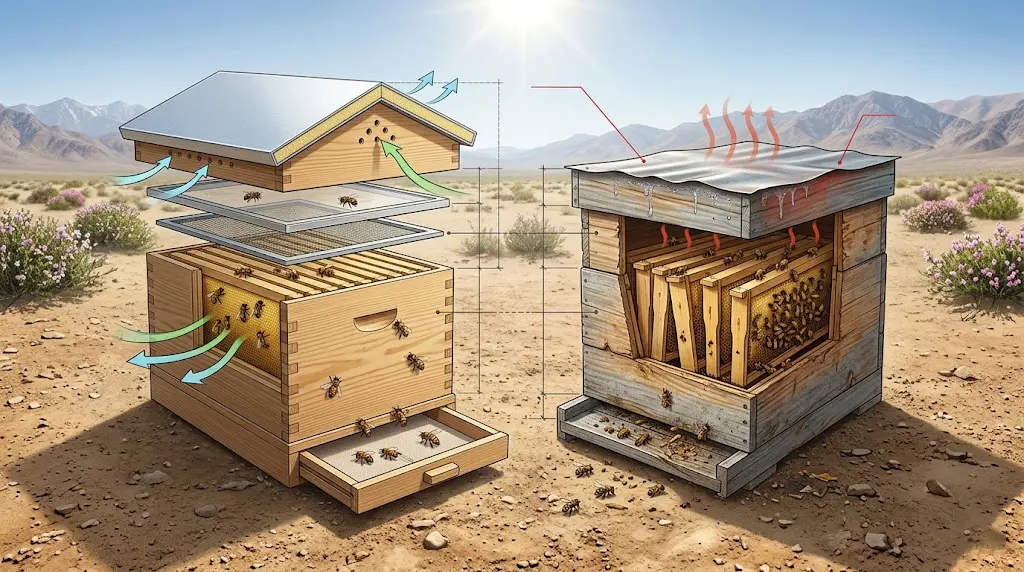
This document is the result of research and a set of proposals regarding honey bee hives in Iran. The necessity for this research arose after Haft Gohar, a manufacturer of beekeeping tools, encountered serious challenges with the lack of uniformity in hives used across different regions of Iran when attempting to manufacture them.
Abstract
The modern honey bee hive (Langstroth type) has been in use in Iran for over 60 years. Over these years, the hive has undergone changes such as the removal of the inner cover, the integration of the body and floor, and a lack of uniformity in the dimensions of the body and frames, which has reduced its efficiency.
Furthermore, the Earth’s climate—and that of Iran—has become warmer over the past 30 to 40 years. Existing hives, not designed for such conditions, are unable to protect colonies during summer heat.
Since the beekeeping industry, like other sectors of the economy, operates in a competitive environment, reviewing the status of the honey bee hive and resolving its shortcomings is essential and inevitable for increasing productivity.
The Iranian National Standards Organization developed the honey bee hive standard (No. 1416) in 1975 and revised it in 1983. However, this standard is neither well-known among beekeepers nor widely utilized. Under these circumstances, the best option to address the shortcomings of the honey bee hive is a second revision of Standard 1416, with the participation of all sectors of the beekeeping industry, followed by the encouragement of beekeepers to adopt it.
Introduction
The honey bee is a nest-building insect that follows specific yet consistent principles in constructing its nest. It builds nests in mountain crevices or tree trunks, storing honey for food, reproduction, and winter survival, often producing a slight surplus. By discovering and managing the natural behaviors of honey bees, humans were able to obtain more honey. Over time, population growth led to increased demand, which gradually caused advancements in beekeeping science, tools, and the industry itself, resulting in higher honey production. Industrial production turned honey into a commercial commodity, which is subject to its own laws and regulations and is closely linked to competition.
Global connectivity and ease of transportation have diminished the prosperity of local and traditional markets, making them no longer safe havens for producers regardless of price or quality. In the Iranian market, various industrial sectors have recently experienced stagnation or closure due to an inability to compete with imported goods, and clear signs of this threat are visible in the beekeeping industry. Although this threat is serious and devastating, if managed, it can be an opportunity for growth and change in previously inefficient processes.
The market requires honey in large quantities with suitable quality and competitive prices. Increasing the number of hives is an inefficient, costly, and ineffective final solution. Instead, one must first look for ways to increase productivity, both in reducing production costs and in raising the amount of honey produced per hive. To increase productivity, all factors affecting this industry must be reviewed in detail.
Factors Affecting the Beekeeping Industry
We begin by introducing the factors affecting the beekeeping industry: a) The beekeeper, b) Trade unions/guilds, c) Government policy-making and executive institutions, d) Scientific and research institutions (universities), e) Related industries, f) Bee breed, g) Diseases, prevention, and treatment methods, h) Territory and migration (transhumance), and i) Hives and tools.
These factors are the interconnected links of the beekeeping industry, and weakness or deficiency in any one will disrupt the industry’s operations.
This document was written to examine the modern honey bee hive in Iran. Upon entering Iran, the modern hive lost some of its features that had been the result of years of beekeeper experience.
Global warming and the climate of Iran require that, in addition to modern hive insulation systems, a new method for protecting colonies during summer heat be designed and implemented.
The inconsistency of hive sizes in Iran has disrupted the internal system of the hive, reducing production and making hive management time-consuming and difficult. The use of modern honey extraction tools for the purpose of cost reduction and hygiene requires uniform frames, which currently cannot be implemented in Iranian beekeeping.
A hive is a capital asset for a beekeeper. Its durability and lifespan play a serious role in the industry’s economy, and it is essential to apply current technologies in its production.
The bee is a nest-building insect, and this fact has led beekeepers to leave the resolution of some hive shortcomings to the colony itself. In circumstances where the goal of beekeeping is to obtain honey and hive products, nest building or compensatory activities by bees to rectify hive defects result in reduced nectar gathering and increased honey consumption. The art of beekeeping lies in ensuring the bee spends as little time as possible on nest building and focuses instead on reproduction, honey gathering, or the beekeeper’s goals.
Efforts to improve the beekeeping industry are important because Iran’s four-season territory possesses the necessary characteristics for the growth and expansion of this industry (comparative advantage), and the bee, as a pollinator, plays a vital role in the biological cycle and the increase of agricultural production.
History of the Honey Bee Hive
The modern hive has a 160-year history. Through many years of observation and precision regarding honey bee behavior, beekeepers were able to discover the features of the honey bee hive, which follow specific and uniform principles. In America, Langstroth, the discoverer of “bee space,” invented a hive now known by his name. In other countries, other models of honey bee hives have been built based on these same principles. Two types of dimensions are considered when building a hive in different countries:
-
Biological dimensions (Mandatory dimensions): These are sizes formed by the bees themselves, which are identical (with slight differences) in most European honey bee breeds (Table 1). These sizes were not created by humans but were discovered.
-
Geographical-Economic dimensions: Beekeepers in different regions of the world, considering climate conditions, beekeeping methods, migration conditions, and sometimes specific preferences, have designed and built various hives. These are sometimes very different from each other but share the same biological dimensions (Table 2).
Among the mentioned hives, the Langstroth hive is one of the most popular among beekeepers worldwide. The current Langstroth hive type has evolved over the years and proven its efficiency. Most modern hives in Iran are also of this type. Before examining the Iranian honey bee hive, it is necessary to briefly describe the American Langstroth hive in terms of design and dimensions to serve as a reference.
Features of the American Langstroth Hive
In this hive, all biological dimensions are incorporated. The hive body is separate from the floor and does not differ from the super, allowing them to be interchangeable. The hive has an inner cover, which creates suitable insulation against heat and cold by doubling the hive roof. The American Langstroth hive lacks interlocking edges, and the connection of its layers is based on weight. This hive must be nailed and strapped when being moved; however, it is still subject to disintegration on rough roads. (Figures 1, 2, and 3).
Note: A portion of the height of the American Langstroth hive sits about 9.5 to 16 mm into the hive floor, which is sometimes hidden from manufacturers who have not seen the hive and attempt to build it from a drawing. The internal height of the American Langstroth hive equals the sum of the super height (244.5 mm) and the floor step height (9.5 to 16 mm), which is 254 to 260.5 mm.
The Langstroth Hive in Other Countries
The Langstroth hive underwent slight changes in coordination with the standards of other countries or the needs of beekeepers in those regions (Table 3). For example, the frame length in the American Langstroth hive, in the imperial measurement system, is 19 inches (a rounded measurement), which equals 482.5 mm. Countries like Denmark, using the metric system, have set the frame length to a rounded 480 mm. Some countries have built 11, 9, 8, or 13-frame Langstroth hives.
The difference between the Langstroth hive in America and other countries does not pose a problem; it is only essential that hive dimensions be uniform within a specific beekeeping economic zone (a region where beekeepers exchange frames and hives), which constitutes a national or regional standard.
Honey Bee Hives in Iran
Like in other countries, factors such as taste, beekeeping method, climate, and vegetation have caused Iranian beekeepers to use different hives. In Iran, the Langstroth hive is used in the greatest numbers, alongside the Dadant, Ardabili, and Najafabadi hives (not to be confused with the Langstroth Najafabadi hive; it is used in limited numbers). The diversity of hive models does not pose significant problems in beekeeping; the important thing is that these different models have uniform dimensions. Since most hives used in Iran are of the Langstroth type, we have examined this specific hive.
The Iranian Langstroth hive, nearly 60 years after its introduction to Iran, is a specific type of Langstroth hive, also known as the “migratory hive.” The empty space under the lid for cluster formation, interlocking edges, handle design, and sliding entrance gate has made moving this hive easier, especially on mountain roads and rough terrain.
The Standard Iranian Langstroth Hive
The Institute of Standards and Industrial Research of Iran and organizations related to honey bees developed a honey bee hive standard for the first time in 1975, and subsequently revised it in 1983.
This standard contains very precise points regarding hive construction. The dimensions of this standard differ from those of the American Langstroth hive. In section 1-4, the distance between the frame wood and the hive wall (bee space) is not observed (Figure 4). In the changes made to the hive floor, the entrance gate was placed in the hive body, as a result of which the body and super are different, and the possibility of interchanging them has been lost.
In section 4-4, the super height is 245 mm, which creates extra distance between the top and bottom frames, disrupting the bee space. No representatives of beekeepers or hive manufacturers were present in the drafting of this standard (Standard 1416, Technical Commission on Honey Bee Hives, p. 1), and this standard is not used among Iranian beekeepers.
Hives Used in Iran
To examine the hives used in Iran, sixteen beekeeping regions were visited; in this method, five samples were selected from hives built in workshops or from beekeepers’ hives, and measurements were taken (Figure 5 – Table 4).
In a comparative study between the dimensions taken in these regions, except for hives created due to manufacturing errors, three series of dimensions are observable; this is because the manufacturers and consumers of these types of hives are aware of their hive dimensions and have insisted on using them.
These three types of hives are:
-
Damavandi Langstroth Hive: The dimensions of this hive have slight changes compared to the American Langstroth hive and are close to the dimensions of the Greek Langstroth hive. With some effort, the floor of this hive can be separated from the body, but due to the installation of the entrance gate in the body, it cannot be interchanged with the super; the body and super of this hive are different. This hive lacks an inner cover or ceiling insulation layer (Figure 6).
-
Najafabadi Langstroth Hive: This is a box-style hive, and its floor section does not detach; the hive has extra space above the frames. This hive lacks an inner cover or ceiling insulation layer. The frame height is 12 mm shorter than that of the American Langstroth hive (Figure 7).
-
Khorramabad, Amol, and Tehran Langstroth Hives: This is a box-style hive, its floor does not detach, and the hive lacks an inner cover or ceiling insulation layer. The frame height of this hive is 5 to 7 mm shorter than that of the American Langstroth hive (Figure 8).
Other Points Regarding the Iranian Honey Bee Hive
In the original design, this hive had a detachable body and floor, but currently, the hives are box-style. In the original design, this hive had an inner cover, which is not used today. None of the hive manufacturers examined had a blueprint of the hive, and the manufacturing error between the master craftsman’s intended size and the built hive is very high. If we use the 7168 DIN grade m standard, considering bee body size and precision in bee space (Table 5), the maximum tolerance for hive length would be 0.8 mm.
Frame sizes also fluctuated greatly, and unsuitable wood was used in their construction. Most frames had warping and deviation at the 90-degree angle, and more than half of the long frames had two wires and the rest had three (the American Langstroth frame has four wires). No metal eyelets were used at the wire-hole passage, and the wires sank into the wood and became loose with slight pressure; furthermore, the bottom bar of the frames did not have a groove.
In examining Iranian Langstroth hives, three major problems are evident:
1. Lack of Uniformity in Hive Dimensions:
The opinion of manufacturers and beekeepers regarding Langstroth hive dimensions is not identical; manufacturing errors are also above the permitted limit. Consequently, there is great variety in hive and frame dimensions. A beekeeper who cannot obtain hives from a single manufacturer with identical dimensions (for various reasons like buying/selling frames and hives) encounters a heterogeneous collection of frames and hives in their apiary. The greatest damage from this heterogeneity in hive and frame dimensions is the disruption of the hive’s basic principle: bee space. Sometimes a frame may stick to the hive floor or to the lower frame, or create a distance with its sides that is greater than the required bee space.
In a hive where there is no passage for bees between the frame and the hive wall or floor, the bee opens its own path inside the frame (Figure 9). However, hive designers did not intend for such a frame to be used, and the basis of industrial beekeeping is the use of the entire frame (Figure 10).
The effective wax-comb surface area difference between a fully drawn frame and a frame with open bottom and side sections is about 5 to 7 percent. The effective volume of the Iranian Langstroth hive is 5 to 7 percent less than the American Langstroth hive.
In conditions where the bees’ wax-comb does not reach the bottom and side wood of the frame, all the weight of cells full of eggs or honey falls on the top bar of the frame. Due to intense summer heat, vehicle vibrations, or shaking of the frame by the beekeeper, such a frame experiences tearing or stretching in the upper cell area, and the torn cells are rebuilt by bees as drone cells (Figures 11 and 12). These cells have an irregular shape, their width equals that of a worker cell, and their height reaches 1.5 to 2 times that of a worker cell; they differ from natural drone cells that bees build by instinct (Figures 13 and 14). The drone cells built by bees are regular hexagons with dimensions of about 5.7 to 6.9 mm, and if a drone bee is born in them, their exterior appearance approaches a circle.
This phenomenon is widespread in Iranian beekeeping, causing an excessive number of drone bees in the hive, resulting in higher honey consumption, Varroa mite proliferation, and the destruction of over 90 percent of frames that could be used for 3 to 4 years. A frame where cells are connected only to the top bar breaks in a honey extractor; the broken comb either becomes unusable or, if reused in the hive, warps and forms drone cells on one side and small cells on the other. The curvature of such frames may cause them to fuse with other frames or disrupt the shape of adjacent frames. Uncapping these frames is difficult due to the uneven surface, and using a capping knife or automatic honey extraction machines is impossible. Finding and controlling the queen is time-consuming in a frame with open internal sides. Removing queen cells in such a frame is also time-consuming, and there is a high possibility that a number of queen cells will escape the beekeeper’s notice. In an unsuitable hive, a large number of bees are always crushed between the top and bottom frames.
The heterogeneous size of hives in an apiary makes the beekeeper’s work with the hive time-consuming and difficult. Frames, supers, half-supers, and outer covers may need to be moved from one hive to another. Sometimes frames must be forced into the hive, and sometimes the frame falls into the hive. Sometimes the hive lid does not close, and sometimes bees pass through the gap in the lid; the same applies to supers and half-supers.
2. Lack of Insulation in the Hive Roof:
A honey bee hive is always located in an open space and exposed to natural factors. Iran is a land with a diverse climate where the temperature difference between winter and summer, and night and day, is vast, and a suitable hive must protect the bee from these temperature fluctuations. In hives built in Iran, the body wood thickness is appropriate, but there are gaps in the body of many of them due to the use of two-piece wood and head-to-head connections. Meanwhile, the least attention has been paid to the most important part of the hive: the roof. Due to the roof wood being hidden under a metal sheet, thin boards with unsuitable connections are used. As a result, the gaps in the wood of 15 to 20 percent of new hives and more than 70 percent of used hives are open, and the metal sheet on the hive can be seen from inside (Figure 15).
There is empty space between the top of the frames and under the lid of the Iranian Langstroth hive, which was originally used to provide extra space for bees to cluster during migration and also to insulate the hive roof. If the hive roof wood is 19 to 20 mm thick and an inner cover is also used above the frames, this distance causes the hive roof to become double-walled, protecting it from temperature changes.
The inner cover, which existed when the Langstroth hive was first introduced to Iran, has been removed from this hive for years, and the thickness of the roof lid wood has decreased, in some cases reaching 5 mm. As a result, this extra space has lost its primary role in insulating the hive; on the contrary, it disrupts the hive’s temperature balance. This space disrupts the bee space in the hive roof, causing “burr comb” on the frames. A very limited number of beekeepers use this space to feed the bees using top feeders, for which a frame feeder is a better alternative.
In cold winter weather, beekeepers use cloth or burlap under the hive roof and on top of the frames to keep the hive warm, and they may also cover the outer surface with plastic or other means. This method has no effect on maintaining the internal temperature of the hive, and the colony’s valuable thermal energy leaks out from the hive roof. Water vapor resulting from the activity of the bee cluster turns into water upon contact with the cold hive roof and drips onto the frames. This water creates a suitable environment for fungal growth and the onset of diseases in the hive, which is one of the serious problems for beekeepers.
In hot weather, the air temperature in the shade and in the sun is very different, and the basis of meteorology in announcing air temperature is the shade temperature. This temperature is much higher in the sun, and in the climatic conditions of Iran, the difference between shade and sun temperature at noon in summer reaches up to 15 degrees. Iranian-built hives with metal roof coverings and thin wood beneath resemble a car parked in the summer sun.
Experiment: The work method with a probe thermometer (Figure 16) was performed in the empty space under the lid of a single-story hive with a 10-frame population, and the following results were obtained (Table 6).
When the inside of the hive gets hot, all the bees’ efforts are directed at regulating the hive temperature. Some bees begin fanning in front of the entrance gate and inside the hive to cool it, and a group goes in search of water. If they fail to cool the hive, they come out of the hive and gather in front of and under the hive. This reaction of the bees is accompanied by honey consumption on one hand, and leads to reduced nectar gathering on the other. Intense heat inside the hive also disrupts the queen’s egg-laying process and the rearing of brood.
3. Box-Style Hive Body Design:
All existing hive types in the world, whether Langstroth or other hives, have bodies and floors that are separate from each other, and Iran is among the few countries where an integrated box-style hive is used. A hive with a detachable floor has advantages that Iranian beekeepers are deprived of, including:
a) The pulse of the colony is in the hive floor, and the beekeeper can diagnose the colony’s status by examining it.
b) Cleaning the hive floor is easy; especially in spring, at the start of colony activity on a sunny and warm day, one can clean the hive floor of dead bees or other materials in the shortest time without opening the hive lid and causing stress.
c) Easily merging two weak hives in the shortest possible time without the need to move frames.
d) In a two-story hive, if the beekeeper, for reasons such as the queen laying eggs in the top story, etc., wants to change the hive’s configuration, they can easily move the top story to the bottom and the bottom to the top without needing to take out the frames.
e) In Iranian beekeeping, there are sometimes a large number of empty hives in the apiary, but the beekeeper needs a super and cannot use them. If the floor and body are separate, the bodies can be used instead of a super.
Many beekeeping techniques require swapping the position of the super with the hive body, which is impossible in the box-style hive design.
Few Notes:
Note 1: Units of measurement, including kilometers, meters, centimeters, millimeters, etc., each have specific applications, and improper use of these units causes wasted time or errors. Measuring hive dimensions with the centimeter unit, which is common in Iran, is prone to measurement and construction errors, and it is essential that this dimension be changed to millimeters. All dimensions recorded in this document are based on the millimeter unit.
Note 2: Most Iranian hive manufacturers and beekeepers measure hive dimensions based on their exterior dimensions, and if changes are made to the thickness of the hive body wood, the internal dimensions of the hive also change, causing the bee space to be disrupted. It is essential that hive construction be based on its internal dimensions.
Suggestions
-
Beekeepers sometimes, due to reasons such as ease of hive transportation, the coldness of the region, vegetation, etc., need a hive smaller than the 10-frame Langstroth hive; therefore, they have started building hives with smaller frames and bodies, which itself causes model variety and creates limitations in beekeepers’ economic exchanges, especially in buying or selling colonies. Alongside this, there is another solution, which is keeping the frame size constant and building hives with fewer frames: “One country, one frame.” With this method, although hive dimensions are different (Table 7), moving, buying/selling hives, and using their frames—which is a common practice in beekeeping—does not cause problems for the beekeeper.
-
Hive construction must be such that the final cost of the hive does not increase significantly.
-
The hive must be buildable by local manufacturers.
-
The hive must be capable of being transported in the difficult conditions of mountainous regions.
This document has focused more on the problem of the honey bee hive in Iran and has not provided a solution, especially in the section on hive dimensions. The reason is the existence of nearly 3.5 million Langstroth hives of the mentioned types in the hands of Iranian beekeepers.
Although there is a very strong will for the standardization of Langstroth hives among Iranian beekeepers, it is natural that beekeepers in each region want the size of the hive they use to become universal, which is itself a very serious challenge against the plan to improve hive dimensions and requires that this work be done with attention to the macro and long-term goals of the country’s beekeeping industry.
Haft Gohar Design and Engineering Company
Explanations
-
Imperial measurement: This is a measurement system invented in England and is now used in England, America, Australia, New Zealand, and some other countries. This system uses a unit called an inch for measuring small dimensions, where each inch is equal to 25.4 millimeters. Divisions smaller than an inch are in fractions.
Example:
3/8 inch equals 9.52 mm
1/2 inch equals 12.7 mm
3/4 inch equals 19.05 mm
12.5 inches equals 320.67 mm
-
Tolerance: The amount of permissible deviation from the standard.
-
DIN: This is the German national standard, which is very close to and sometimes identical to the international ISO standard.
Sources:
-
www.dave-cushman.net
-
www.honeyshop.co.uk/index.html
-
www.beesource.com
-
Haft Gohar Design and Engineering Company
-
Standard 1416 – Honey Bee Hive Characteristics http://std.isiri.org/userstd/stdsearch.aspx


